How to Repair Relationship Conflict: The Big Five
"I just need you to listen and understand what I'm feeling, but it's like you can't do that and you just shut down."
"I want space to process this myself, but whenever I try to do that you try to keep me with you.
"Can you please just understand instead of rushing in to tell me what to do?"
"Can't you see I am stressed? Today was a wreck and I'm hungry too… It's like you have no idea what I'm feeling."
These are just a few of the phrases many of us have heard or said to the people we love.
These phrases capture moments of relationship conflicts that are painful, frustrating and confusing. At its core, relationship conflict is a breakdown in understanding. Two people are struggling to build a bridge between their different experiences. These types of conflicts are inevitable, but they are also important opportunities to better understand ourselves, better understand the people we love, and strengthen our relationships. In fact, conflict that is repaired well is a major part to developing a healthy, resilient relationship.
For many of us, relationship conflicts are a challenge. They can be painful, unproductive and isolating. We often don't know how to navigate them and so therefore avoid them, shut down or lash out in anger. Avoiding them or lashing out only leads to blow ups and breakdowns. Learning how to repair conflicts, and making a habit of doing it, is one of the keys to building loving, honest, and healthy relationships.
We have to be careful of the idea that a "perfect relationship" has no conflict or disagreement. Of course, it feels good when our relationships are going this way. But the reality is with two people who have different internal experiences and temperaments coming together for long periods of time, there are bound to be disagreements. We tend to think that if our relationships are going well we shouldn't be having disagreements. However, these disagreements can be seen as opportunities to grow, develop and create more harmony in the relationship.
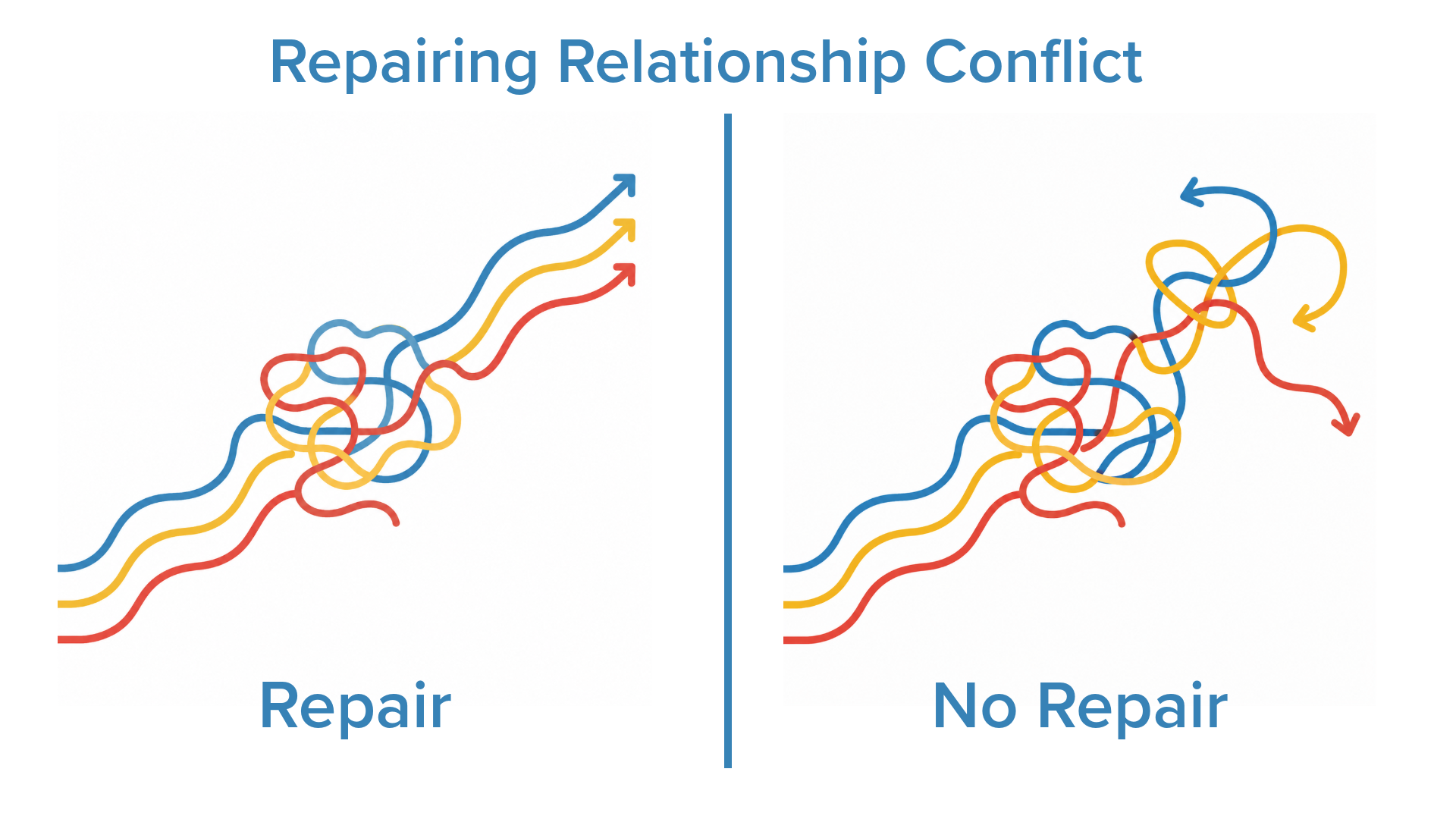
Repairing relationship conflict leads to continued growth and evolution. Without repair, moving forward can be unclear, inefficient and painful.
When we have a conflict with someone and all we have is “I am right and you are wrong,” there is little possibility for connection, understanding or growth. But when we can apply a few skills to the conflict, we can actually transform what feels like a dead end into an opportunity for greater understanding on both sides. With continued practice, this leads to harmony and a feeling of growing together. How we navigate these differences is crucial for creating healthy, growing relationships.
It's easy to find ourselves saying, " Can't you just accept it?" or some variation of "I’m right and you’re wrong.”" Or my personal go-to when I'm not being particularly wise…the tempting but naive remark "Why can't everyone just be happy?"
As tempting as these thoughts can be, they don't lead to repair or reconciliation. The pathway to harmonious, resilient relationships is being honest about differences in views and experiences, understanding each other, being willing to change and moving forward together more evolved than before.
Repairing conflict is vital because it leads to a deeper understanding of yourself, the person you are in relationship with, and the patterns that exist between you. The more we understand those patterns, the better we become at navigating them together. So let's take a closer look at what the repair process actually involves.
What is Repair?
Let's take a simple example.
A couple argues because one person wants some time alone while the other person wants to connect. There could be lots of reasons for their different experiences, but at that moment they are struggling to understand their own experience, communicate it to each other, and understand each other.
Because there is no bridge of understanding where both people are getting each other's experience, they are stuck shouting back and forth and shutting down. Each person wants to be understood, but nothing is coming through to either side. They feel disconnected, angry and misunderstood.
So what do they need to do?
Come back together and repair the rupture in their connection, of course!
Repair is the process of coming together again after a breakdown to reestablish the broken sense of resonance and connection in the relationship that has been disrupted. In simple terms, this is “talking it through” or “making up”. It is easier said than done and involves a dance of a variety of skills.

“Repairing relationship conflict is, at its best, a complicated but beautiful dance of observing our reactions, understanding ourselves, understanding the other person all while the other person is attempting to do the same.”
First, we need to be able to know what is happening inside of us. We need to monitor it and communicate it in a relatively regulated state. In other words, we need to know what is happening for us…our thoughts, feelings, needs and reactions… and then manage that experience enough to speak about it without getting overwhelmed with emotion.
We also need the ability to hold both our experience and the experience of the other person in awareness. This means we have to see the world of the other person. We have to understand their perspective. We need to be able to reflect on their state of mind.
And guess what? The other person has to be trying to do the same thing.
Repairing relationship conflict is, at its best, a complicated but beautiful dance of observing our reactions, understanding ourselves, understanding the other person all while the other person is attempting to do the same.
It is a difficult process, indeed.
So let’s slow it down and look at the Big Five abilities that can help us navigate it.
The Big Five of Relationship Repair
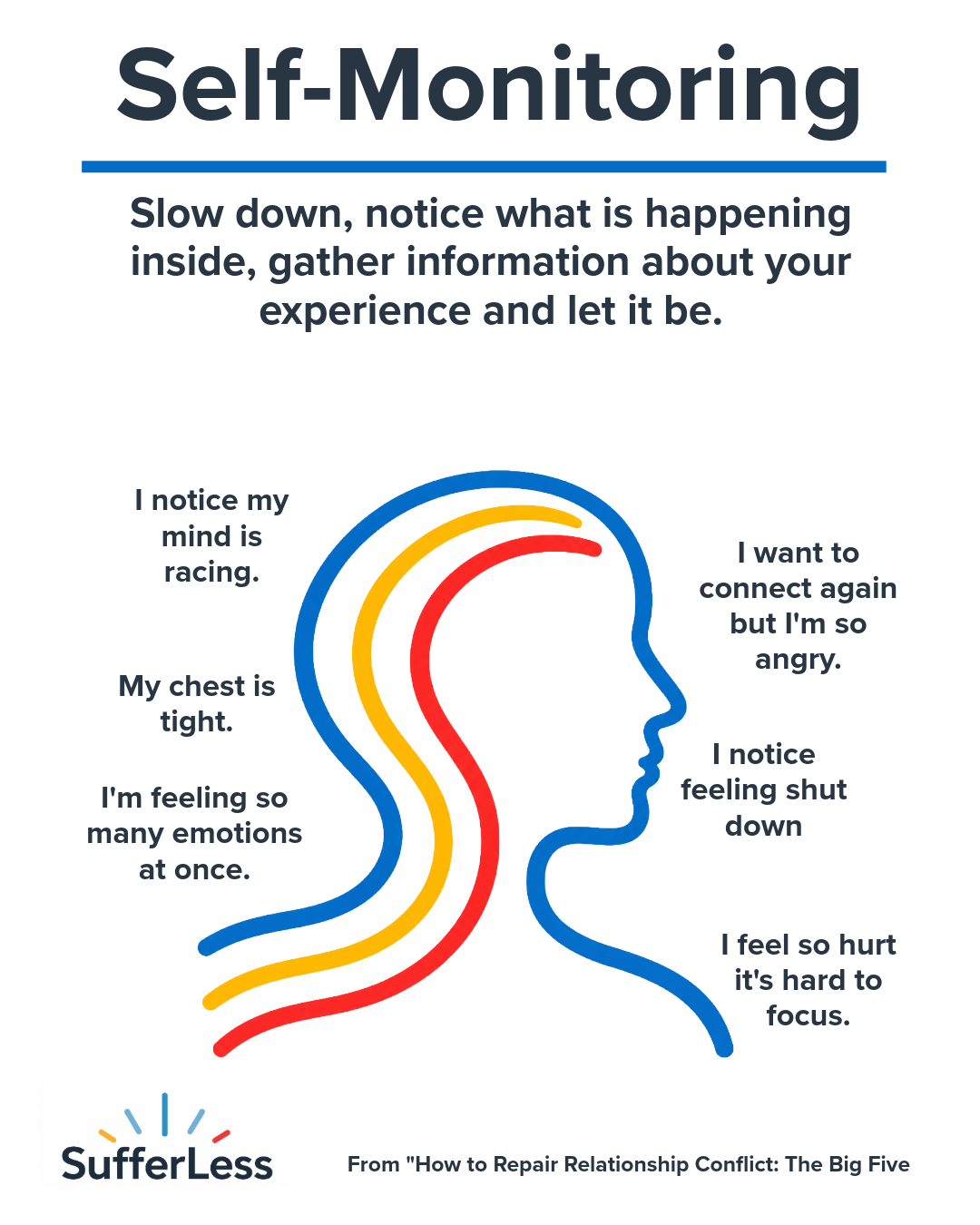
1. Self-Monitoring
What it is: Our ability to observe and understand what is going on inside.
Why it matters: It’s important to slow down, observe and find out what is happening in you. Doing so reduces reactivity, cools the intensity of what is happening, and makes it possible for you to have a clearer understanding of your experience.
How can I do it: Ask yourself, “What is happening for me now?”
It is important to just be with what you observe. Note it, name it and allow it to be without immediately trying to fix it, defend against it, or escape it.
What it sounds like: “I’m noticing feeling defensive. My body is getting tight, my thinking is getting very black and white and extreme.”
Core skill: Slow down, notice what is happening inside, gather information about your experience and let it be.
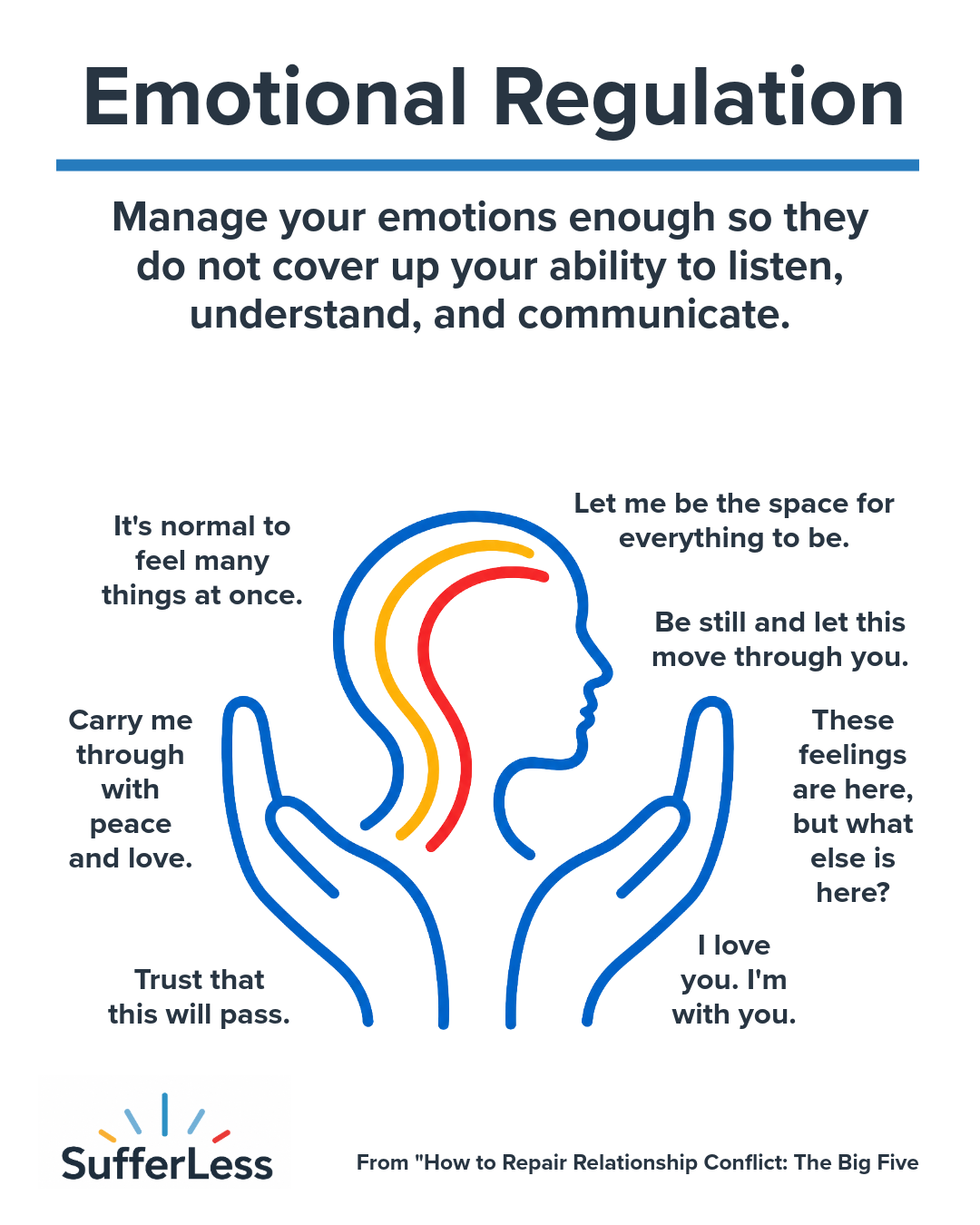
2. Emotional Regulation
What it is: The ability to manage the flow of experience enough so that you can be with your emotions without them overwhelming you.
Why it matters: If our emotions become too intense, they can overwhelm us to the point that we can't listen, think clearly, or communicate well. We need to observe our emotions, put words to them, and use them as guides to help us navigate our experience, but not let them become the sole center of who we are.
How can I do it: The fundamental skill in emotional regulation is being with your experience in a way that is open, accepting, curious and loving. Bringing this kind of intention toward your inner experience is soothing. It also makes other skills, such as breathing techniques, questioning our thinking, and many other coping skills, more effective and easier to use.
What it sounds like:
“Just allow this to be. Don’t resist it. I can be with this until it passes.”
“What is this feeling telling me?”
Core skill: Manage your emotions enough so they do not cover up your ability to listen, understand, and communicate.
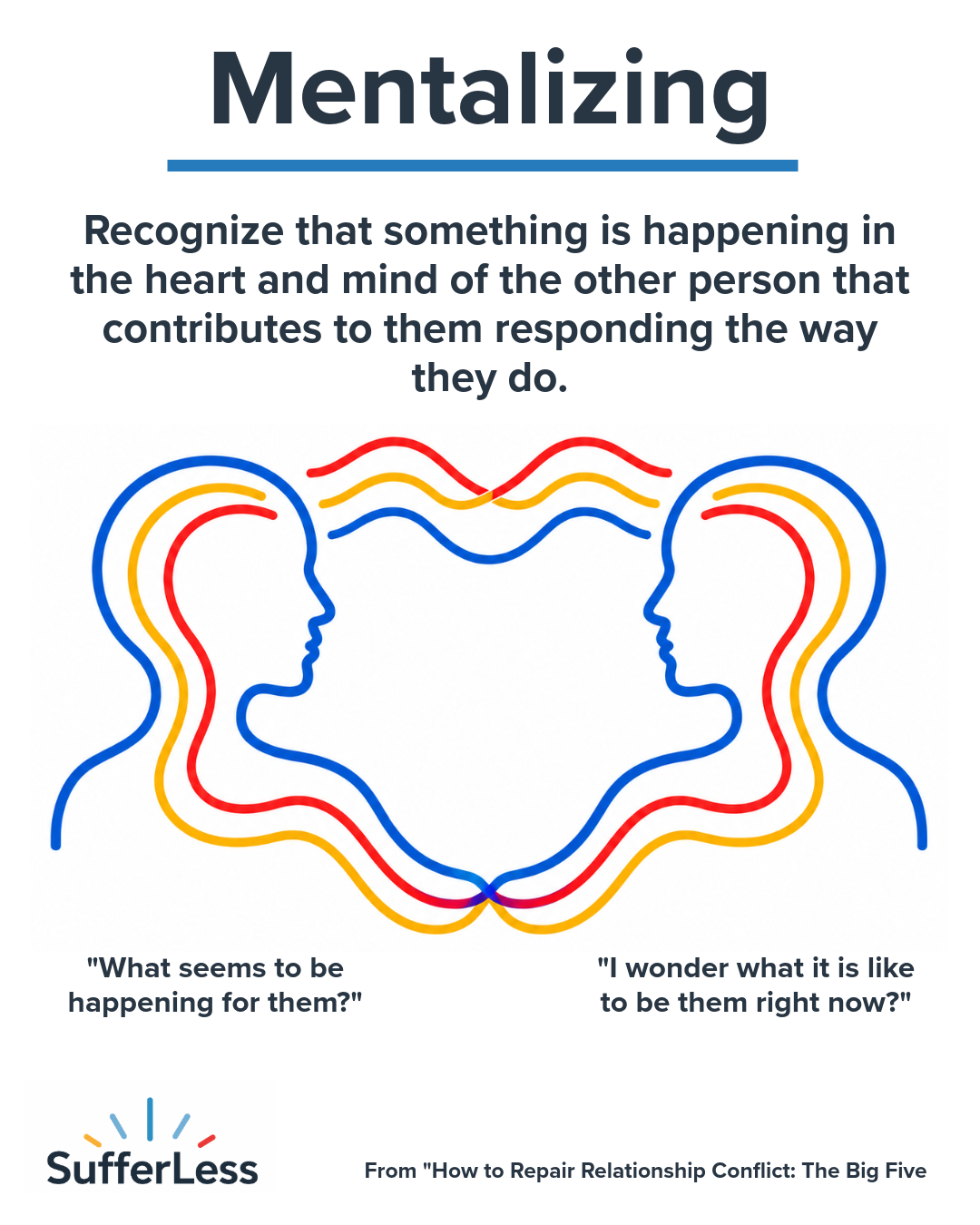
3. Mentalizing
What it is: Our ability to reflect on the state of mind of another person.
Why it matters: Very often, when we are upset we have trouble “seeing the other person” or, in other words, reflecting for a moment on what is happening for them.
This is important because when we repair a breakdown, we need to understand that something was happening in the heart and mind of the other person that contributed to them responding the way they did.
This allows us to keep their “mind in mind” and sets the stage for open understanding. We need to see their experience as much as they need to see our experience. In this way, both people feel seen and understood.
How can I do it: We can ask ourselves:
"I wonder what it is like to be them right now?"
"What seems to be happening for them?"
"I am noticing this is happening in me. I wonder what it was like for them?"
Notice how this skill involves a deep sense of wonder and enough space in awareness to hold your own experience while also reflecting on the experience of the other person.
What it sounds like: “This is what happened for me… but I am wondering what it was like for you?” (After reflecting) "It sounds like ___ was happening for you in that moment."
Core skill: Remember that the other person you are with is having an internal experience, too. Let your awareness be open enough to hold both your experience and theirs.
4. Loving Honesty
What it is: Stating what appears to be true in the most loving way possible. Through our ability to observe ourselves instead of simply reacting, we can develop a clearer sense of what is happening for us. Of course, our ability to do this is never perfect, but we can often get closer to what feels true for us in that moment.
As we discover what is true, we can share it and do so in the most loving way possible.
This requires vulnerability. It means setting the intention to be as loving as possible while remaining as honest as we can.
Why it matters: Generally, in relationships we want to love and be loved, but all of our human junk gets in the way.
Our defensiveness, fears, need to control, need to be right, and many other reactions can make it difficult to love and be loved well.
Setting the intention to be loving makes the goal clear. We are in this interaction to move back toward love, understanding, and harmony - not to be right, control, or put the other person down.
The second intention, to be truthful, keeps us aligned with reality as much as possible.
This is what appears to be true right now, so let's work with that.
Truth without love can be harsh and love without truth can keep you from facing reality.
How can I do it: Do your best to say what is true for you.
You will notice that truth often has many sides to it and can sometimes even feel contradictory.
You will also notice that speaking what feels true can be vulnerable, painful, or connected to strong emotions. Hearing what is true can be painful as well.
On the other side of that discomfort is the possibility of being grounded in reality and working with what is actually here.
Being as loving as possible when sharing and receiving truth helps soothe some of the pain that can come with difficult conversations and allows us to orient ourselves in the most helpful direction possible.
What it sounds like: "I know this is hard and I am in this with you, but it also hurts a lot and makes me angry when you shut down. I want to hear your side of it, but I also really want you to put effort into making this work better for us."
Core skill: Say what appears to be true in the most loving way possible, even when it feels uncomfortable or vulnerable.

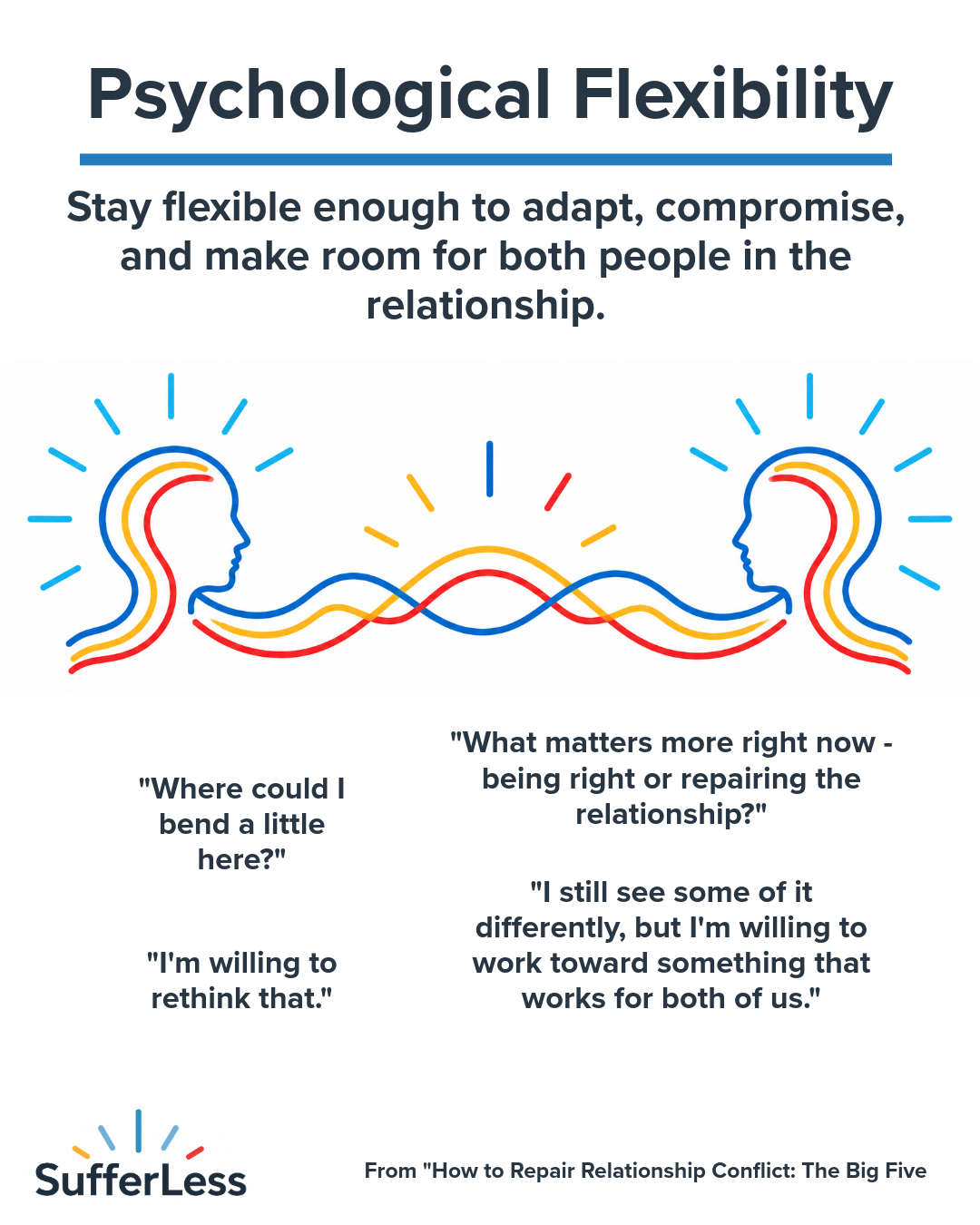
5. Psychological flexibility
What it is: Our ability to stay open, adapt, and bend when needed instead of becoming rigid and stuck.
Why it matters: Many conflicts continue not because people do not care about each other, but because neither person is willing or able to move.
Repair often requires us to loosen our grip a little. To become open to another perspective, willing to reconsider our position, willing to compromise, or willing to change our behavior for the good of the relationship.
It is important to realize that we can be strong in who we are and still be flexible. We can be grounded in ourselves while remaining open enough to bend, adapt, and grow together.
How can I do it: Notice when you become attached to being right, winning, controlling the outcome, or having things happen only your way.
Ask yourself:
"Where could I bend a little here?"
"Is there room for compromise?"
"What matters more right now - being right or repairing the relationship?"
Do not become so attached to your perspective that you lose sight of the person in front of you.
What it sounds like:
"I can see why that matters to you."
"You know... I think you're right about that."
"Maybe we can meet somewhere in the middle."
"I still see some of it differently, but I'm willing to work toward something that works for both of us."
"I don't think it has to be either your way or mine."
"I'm willing to rethink that."
"Maybe I don't have the whole picture yet."
Core skill: Stay flexible enough to adapt, compromise, and make room for both people in the relationship.
So if we take all of these abilities and say them simply:
Observe your world.
Wonder about and respect the other person's world.
Speak the truth with love.
Stay open enough to bend and grow.
Why is it so important to repair relationship conflicts?
Coming back together and resolving these ruptures in connection is vital for developing and preserving trust and security in our relationships. The process of repair brings us back to the connection, trust, and love that make healthy relationships possible. Despite it being uncomfortable, returning to the relationship to repair is essential for preserving and strengthening that bond.
Repair creates a culture of trust.
Continuous patterns of repair when there are conflicts establish a culture of trust, consistency, safety, and integrity in a relationship. You are building a relationship culture that says. “When things go bad, we will come together and make them right. We have the courage and vulnerability to face what isn't working by listening to and understanding each other.”
The opposite of this is having continuous conflict with no resolution. It is the denial of the reality of the conflict for temporary comfort and, if it becomes a pattern, can lead to a lifetime of discontent, resentment and disconnection.
Conflict resolution does not have to be graceful.
It is also important to recognize that conflict resolution doesn't need to be a peaceful, quiet, or graceful experience. Sometimes it goes that way, but other times it can be messy, emotional, and full of difficult truths being spoken back and forth. Speaking these truths can bring up anger, sadness, grief, confusion, overwhelm. Many of us think, "If we're raising our voices or crying or emotional, we're doing it wrong." But emotion itself is not the problem. What matters is staying with the principles of being honest, staying regulated enough to hear and understand the other person, observing your own experience, and remaining flexible enough to keep moving toward connection.
So there you have it.
A set of guiding principles to repair relationship conflict when it happens.
If you can keep some sense of these principles operating, you can navigate the authentic, messy conflicts that happen on the drive to Thanksgiving dinner, while trying to get out of the door for work in the morning, or in the many ordinary moments where relationships become difficult.
So the next time you're arguing in the minivan, shutting down in the hallway, or feeling disconnected across the dinner table, take a moment and remember:
Let me be curious, open, and honest about my own experience.
Let me remember that the person in front of me is having an experience, too.
Let us stay open enough to learn from each other, compromise when needed, and find a way forward together.